Two weeks ago, I saw The Odyssey in IMAX. It was epic (get it?). I’m still reflecting on the movie and my take on it. Kris Puckett recently made a fun app called The Definitive Nolan Ranking. Christopher Nolan is the second-best director working today, and his body of work is impossibly hard to stack-rank. You can’t go wrong. It inspired me to do a similar exercise for the creative technologists and design engineers out there: ranking essays and talks by Bret Victor.
If you build or use creative tools, there’s a good chance Bret Victor’s talk “Inventing on Principle” was a canon event in your career—the spark that inspired you to take a different path. Victor is the founder of Dynamicland and a former engineer on Apple’s prototyping team.
Victor delivered this talk at the inaugural Dropbox DBX conference. He explores the ideas of the ’70s that unlocked programming for more people. By the time of his talk, progress had become conservative—a faster horse built from text files, batch compilation, and indirect feedback loops. He argues that we mistakenly pursued incremental progress instead of leapfrogging the industry toward live visual feedback, direct manipulation of behavior, and domain-specific representations beyond text.
The future of programming will not come from adding tools around the edges of today’s model, but from reimagining programming as an interactive, visual, learnable medium for thinking—especially for non-experts. He closes by urging the audience to reject incrementalism and pursue radically better ways for humans to see and shape computational systems.
Throughout my career, I’ve learned that the most interesting tools don’t simply make an existing workflow faster; they question why the workflow exists in the first place. At Replit, especially as AI became part of the product, I saw programming begin to shift from editing syntax toward expressing intent and shaping a running system.
Especially relevant in the LLM era, “Magic Ink” argues that software should be thought of as information design before an interface full of controls. In most applications, the user’s real goal is to learn, decide, or understand—not to operate machinery. The central design problem is showing the right information at the right time, not creating buttons and menus. Victor criticizes the prevailing “click-and-drag” paradigm as a legacy of physical tools. Instead, he frames software as a medium that can read the user’s context and proactively present relevant information, like a newspaper constantly rewriting itself around what you care about and what’s happening.
Victor proposes that software must infer what the user wants from where, when, and what they are doing: their history, past choices, location, schedule, and the structure of the information itself. The designer’s job becomes crafting systems that observe these signals and respond with tailored visual representations instead of forcing the user through rigid interfaces.
Though I don’t share Victor’s critique of direct manipulation, I do believe these controls are too rigid. His ideas connect to what I wrote in Dynamic Interfaces: the future of computing will be contextual, shaped by memory, and presented through the right UI for the moment. “Magic Ink” ultimately reframes good software as quiet, anticipatory, and visually rich—less like a tool you drive and more like a responsive, informative environment you inhabit.
I’ve learned that adding more controls rarely makes software feel more powerful. The best interfaces understand enough about the person, their work, and the moment to present what matters. That lesson shapes how I think about Dynamic Interfaces: AI should not replace every interface with a prompt; it should help interfaces become more contextual.
This talk challenges designers to break out of static representations and breathe life into them. Instead of drawing a static interface in a UI tool, Victor pushes us to explore interactivity—to move from lifeless fish to an interactive ecosystem.
He shows tools where you sketch something and directly demonstrate how it should move or react instead of writing math or code. A character can be animated by dragging its limbs, a flock guided by example rather than formulas, and a scene made to respond to your actions in real time. The deeper point is that artists and kids shouldn’t have to become traditional programmers to work with dynamic systems. When people can manipulate examples and see immediate feedback, animation and interactive behavior become intuitive media. We’re no longer “drawing dead fish,” but creating living, responsive worlds.
Webflow taught me that the best way to understand an interactive product is to make the design interactive as early as possible. Static mockups can communicate appearance, but prototypes reveal behavior, timing, and feel. Throughout my career, prototyping has been less about demonstrating a finished idea and more about discovering what the product should become.
“Inventing on Principle” is Bret Victor’s talk about anchoring your work in a deeply held moral belief and letting that belief drive what you create. He describes how, for him, the principle is that creators should be able to see and manipulate what they’re making in real time. From this, he builds programming tools where changing code immediately changes the output—no compile/run cycle, no guessing. You can tweak variables and logic and instantly see animations, UI, or game behavior respond, turning programming from blind editing of text into a direct, visual conversation with the system.
This talk is often misunderstood, much like Nolan’s Inception. The film’s title refers to planting an idea in someone’s mind through a dream, not its three levels of dreams. Likewise, “Inventing on Principle” is not really about direct manipulation or real-time visualization. It’s about finding the principles that guide how you invent.
He contrasts this with how most of us pick projects: following trends, copying others, or chasing vague “impact.” Instead, he highlights people like Alan Kay, whose work came from a clear sense of what must (and must not) exist in the world. The talk is both a demo of responsive programming environments and a challenge: find the principle you care about so much that it makes you angry when reality violates it, then let that anger guide what you build. In his view, the future comes from people who remain uncompromisingly loyal to such principles and “invent on” them instead of tinkering with what already exists. The principle that has guided my career is to seek paradigm shifts: leapfrog the existing system and let everything else follow.
It may be blasphemous not to put “Inventing on Principle” at number one, much like ranking any Nolan film above Interstellar. But my favorite Nolan/Victor pairing is Inception and “Up and Down the Ladder of Abstraction.” Inception is one of the best systems-design movies ever, and Victor’s talk explores shifting between representations—and why tools should make those shifts easier to see.
Using the website’s iconic interactive example—one car with cruise control trying to maintain its distance from another—he shows multiple “rungs” on a conceptual ladder: a specific moment with exact positions and speeds; time-based plots of distance or velocity; general rules like “accelerate when too far, brake when too close”; and finally, abstract control-system patterns that apply beyond cars. Each rung hides some details and highlights others, so different questions are best answered at different levels.

Powerful thinking means moving up and down these levels fluidly, not getting stuck on one. Abstractions reveal structure and invariants—for example, that the following car should never collide—while concrete simulations expose edge cases and build intuition. Victor argues that traditional static media, such as equations and fixed diagrams, trap you at a few levels and make this movement slow and mental. His explorable essay instead lets you drag cars, change parameters, and watch behavior shift across multiple representations at once. This makes his larger point tangible: tools that support understanding should expose many representations and provide immediate, manipulable feedback. You can see how an abstract rule plays out in specific situations and adjust your understanding on the fly.
This has become the most practical lesson of my product-design career. No-code and code are not opposing philosophies; they are different positions on the same ladder of abstraction. The goal is not to choose one level for everyone, but to help people move between intent and implementation, visual manipulation and source code, simplicity and control—without losing agency along the way.
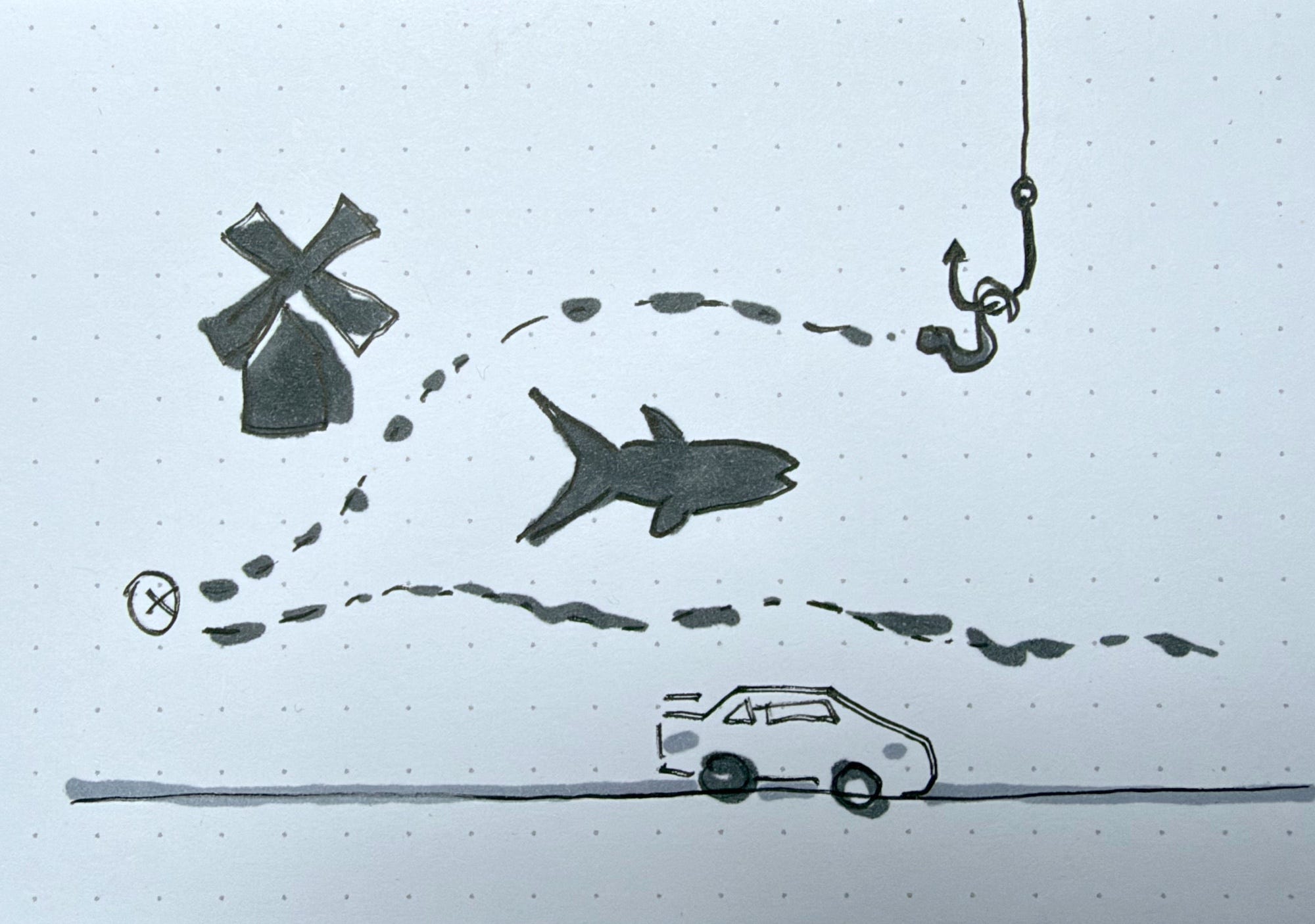
The more I study the craft of software, the more amazed I am by how far ahead some people’s visions were. Most of Bret Victor’s work shared here is more than a decade old. Yet in an AI era of apparent magic, his work matters more than ever. We need visible information systems that give creators control.
Conversational to agentic: AI personality, one year on | Amrita Saraogi → A great read by our first Content Designer at Webflow
On being an elder by Josh Puckett
Bret Victor’s complete body of work — Essays, talks, experiments, and Dynamicland work
Proof of Concept #49: Talks that shaped my design philosophy
Dynamicland: A six-minute introduction — Victor’s current work and the idea of communal computing
Getting to the source — How “Inventing on Principle” inspired Webflow and Victor’s later critique of the product
AI-Instruments — Connecting generative AI with reusable, direct-manipulation interface objects